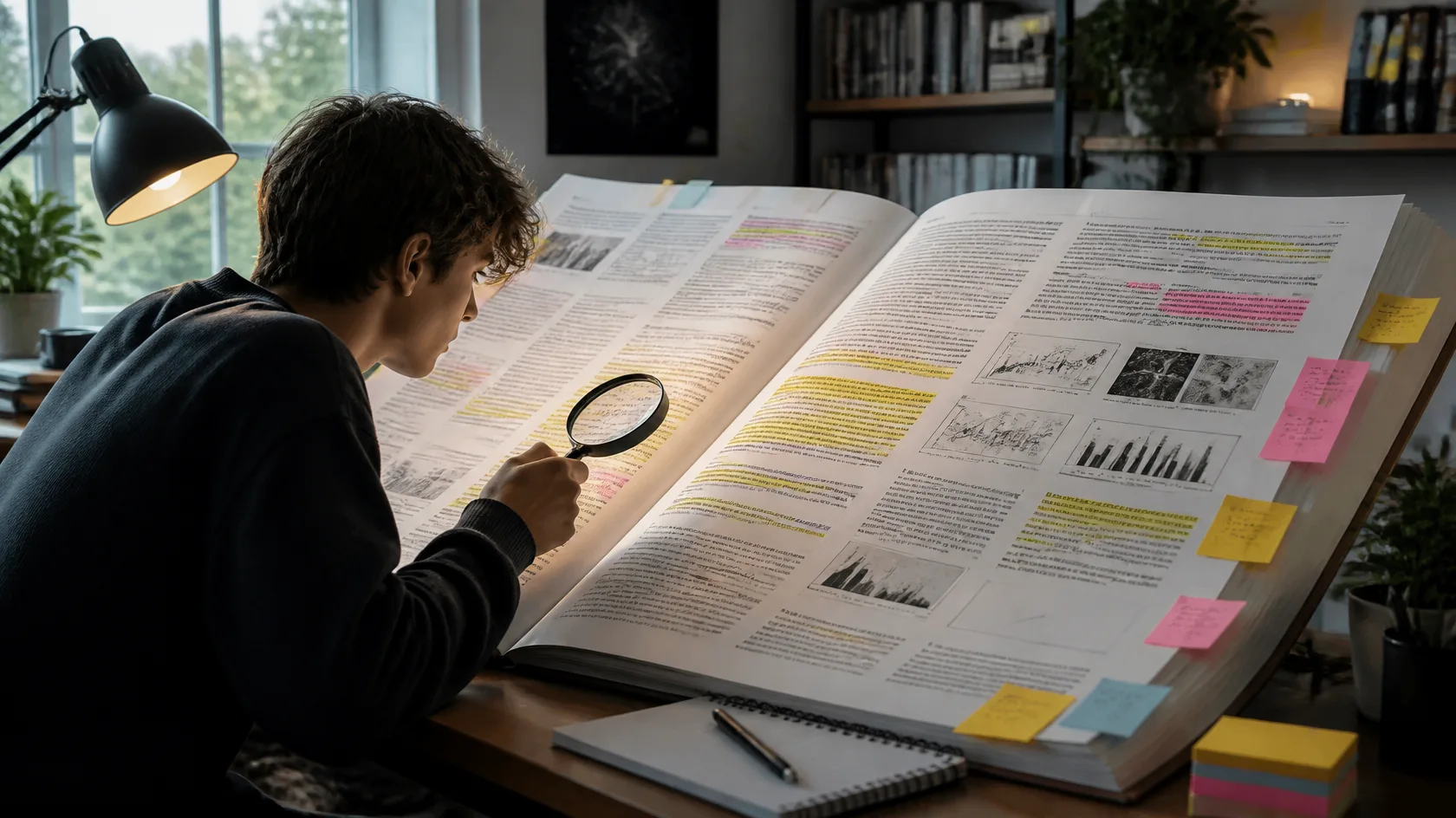
Paraphrasing Without Plagiarism: A Student's Safe Workflow
Paraphrasing is not swapping a few words and hoping for the best. Learn the five-step workflow that turns a source into genuinely original writing, with worked examples, a patchwriting checklist, and the citation habit that keeps you safe.
Almost every student has done it. You find a sentence that says exactly what you want to say, you change a few words, shuffle the order a little, and paste the result into your essay. It feels like paraphrasing. It reads like paraphrasing. And then a similarity report lights it up anyway, or a marker writes "too close to the source" in the margin, and you are left wondering what you did wrong. The answer is that word-swapping is not paraphrasing. Real paraphrasing means understanding an idea well enough to explain it as if the source were closed, in your own sentence structure, and then giving the source credit anyway. This guide teaches that as a repeatable workflow, so you can use sources confidently instead of nervously.
What paraphrasing actually is (and what it is not)
A good paraphrase keeps the meaning of the original and changes almost everything else: the sentence structure, the order of ideas, and most of the wording. It is usually about the same length as the original, because it covers the same ground. That is what separates it from a summary, which shortens, and from a quotation, which keeps the words exactly. Three tests tell you whether you have really paraphrased:
You could explain the idea out loud without looking at the source. If you cannot, you have not understood it yet, and no amount of word-swapping will fix that.
Your sentence structure is your own. If your version follows the original clause by clause, with only the adjectives changed, it is still the author's writing wearing a disguise.
The source is cited. A perfect paraphrase without a citation is still plagiarism, because the idea is not yours. Changing the words never removes the need to credit the thinker.
Why word-swapping gets flagged
The habit has a name in academic writing: patchwriting. It happens when a writer stitches together lightly altered phrases from a source, keeping its structure and most of its vocabulary. Students usually do it without any intention to cheat. They do it because they are unsure of the material, short of time, or afraid that their own phrasing will sound less academic. But markers and similarity checkers are both good at spotting it. Checkers compare strings of words, and patchwriting leaves long matching strings. Markers notice something subtler: a sudden jump in vocabulary and sentence complexity, where one paragraph sounds like a journal and the next sounds like you.
The table below shows the difference with a made-up example sentence, so you can see the line clearly. The original is invented for this guide, not taken from a real paper, and the same principle applies to real sources.
Version
Text
Verdict
Original (invented example)
Regular aerobic exercise improves working memory in older adults by increasing blood flow to the hippocampus.
The source, as written
Patchwork copy
Regular aerobic activity enhances working memory in older adults by boosting blood flow to the hippocampus.
Not a paraphrase: same structure, only synonyms swapped
Good paraphrase
Older adults who exercised regularly showed stronger short-term memory, and the researchers linked the improvement to better circulation in the brain region that helps form new memories.
A real paraphrase: new structure, new wording, same meaning, still needs a citation
Notice that the good paraphrase is not shorter or fancier. It is simply rebuilt: the sentence starts somewhere else, the ideas arrive in a different order, and the technical terms are explained rather than repeated.
The five-step safe workflow
This workflow takes a few extra minutes per source, and it saves you from the two most common problems: accidental patchwriting and the blank-page panic of trying to write while staring at the original. Do it on paper or in a notes document, not directly in your essay draft.
Read the passage properly. Read it twice if you need to, and make sure you could explain it to a friend. If a term is unclear, look it up now. You cannot paraphrase what you do not understand.
Close the source. Put the book down, switch tabs, or cover the page. This step is the whole trick. Writing with the source in view is what produces patchwriting, because your eyes keep borrowing its phrasing.
Write the idea from memory, in your own words. Do not worry about sounding academic. Write it the way you would say it. Accuracy matters here, not elegance.
Reopen the source and compare, line by line. Check two things: did you keep the meaning intact, and did any phrases survive word for word? Rewrite anything that matches, even a distinctive three or four word phrase, unless it is a standard term that has no good alternative.
Add the citation immediately, while the source is open. Note the author, year and page if you have it. A paraphrase with its citation added is finished work. A paraphrase saved for later citing is a future mistake.
Read first, then close the source. Writing from memory is what forces your own sentence structure to appear.
Four techniques that change the writing, not just the words
Once the source is closed, these techniques give your memory draft a shape of its own. You do not need all four every time. One or two, applied honestly, is usually enough.
Change the sentence structure. Turn a long sentence into two short ones, or combine two short ones. Move the main point to the front if the original buried it at the end, or start with the cause instead of the result.
Change the order of ideas. If the original lists three findings in one order, present them in the order that matters for your argument. Reordering forces you to rebuild the connections between ideas in your own words.
Explain technical terms instead of repeating them. Where the original says "hippocampus", your version can say "the brain region that helps form new memories" the first time, if your reader needs that explanation. Explaining is paraphrasing in its purest form.
Shift the voice and the emphasis. An original written in the passive voice ("participants were tested") can become active in your version ("the researchers tested the participants"), and a detail that was a side note in the original can become your opening point if it matters most to your argument.
When to quote instead of paraphrasing
Paraphrasing is the default, but some passages should be quoted word for word, inside quotation marks, with a citation. Quoting is the honest choice when the wording itself is the evidence or the point.
The author coined a phrase, or the wording is famous, distinctive, or contested. Changing it would weaken or distort the point.
You are analysing the author's language, not just reporting their finding. A literary critic, a historian and a law student all quote for this reason.
Any paraphrase would be longer, clumsier or less precise than the original. A definition is the classic case: paraphrasing a precise definition usually makes it vaguer.
Your reader needs to see exactly what was claimed before you agree or disagree with it. A short quotation sets up a fair argument.
Keep quotations short and rare. An essay built from long quotations reads like a collage of other people's writing, and markers notice that too. As a rough guide, if more than about a tenth of your essay is quoted text, you are leaning on sources instead of using them.
Paraphrasing still needs a citation
This is the rule students break most often, and it is the one that costs the most marks. A citation is not a reward for copying words. It is a record of where an idea came from. If the idea came from a source, cite the source, whether you quoted it, paraphrased it or summarised it. The only ideas that need no citation are your own original arguments and genuinely common knowledge in your field, like the fact that water boils at 100 degrees Celsius at sea level. When you are unsure whether something counts as common knowledge, cite it. An unnecessary citation costs nothing. A missing one can cost a grade.
Handy tip
Cite as you write, not at the end. Every time you finish a paraphrase, add its citation before moving on. The students who get caught by plagiarism checks are rarely dishonest. They are usually students who meant to add citations later and ran out of time.
The best test of a paraphrase is saying it out loud to someone else. If you can explain it without the source open, it is yours to write.
Common traps, and how to dodge them
The thesaurus trap. Swapping every word for a synonym produces sentences that are technically different and obviously borrowed, and often wrong, because synonyms rarely mean exactly the same thing in context.
The single-source paragraph. A paragraph that paraphrases one source from start to finish, even with a citation, reads like a rewrite rather than an argument. Bring two sources into conversation, or add your own evaluation, and the paragraph becomes yours.
The unmarked middle. You cite a source at the start of a paragraph, then keep drawing on it for three more sentences without another citation. Readers assume the later sentences are yours. Repeat the citation, or signal clearly that you are still reporting the same source.
The almost-quote. A distinctive phrase kept intact inside a paraphrase, without quotation marks, is still a quotation in disguise. Either quote it properly or rewrite it fully.
The translated copy. Paraphrasing a source from another language, or running it through a translation tool, is still using that source's ideas and structure. It needs a citation just like any other paraphrase.
Troubleshooting: when paraphrasing feels impossible
The passage is too technical to restate. That usually means you need background reading, not better synonyms. Read a textbook chapter or a review article on the topic first. Once the concepts make sense, the paraphrase often writes itself.
Your version keeps coming out identical to the original. Close the source, wait ten minutes, and explain the idea out loud before writing anything. Speaking forces you into your own phrasing in a way that typing while reading never does.
You are afraid your version sounds too simple. Simple is good. Markers reward clarity, and a plain, accurate paraphrase beats a tangled, impressive-sounding one every time. Academic writing is not about sounding academic. It is about being precise.
The similarity report still flags your paraphrase. Check what it flagged. If it flagged a cited paraphrase with a few matching technical terms, that is usually fine, and your marker will judge it as a human. If it flagged long matching strings, go back to the workflow: close the source, rewrite from memory, and compare again.
Paraphrasing well is a skill, not a trick, and like any skill it gets faster with practice. The workflow feels slow the first few times, then it becomes the way you read: understand, close, explain, check, cite. Students who work this way stop fearing similarity reports, because they know every idea in their essay is either theirs or credited. That confidence is the real payoff, and it is worth the extra few minutes per source.
Frequently asked questions
Is paraphrasing without a citation plagiarism?
Yes. Plagiarism is about ideas as well as words. If the idea came from a source, the source must be credited, whether you quoted it, paraphrased it or summarised it. Changing the wording never removes the need for a citation.
How much do I need to change for a paraphrase to count?
There is no percentage that makes a paraphrase safe. What matters is that the sentence structure and most of the wording are your own, and that the meaning is preserved. If your version follows the original clause by clause with only synonyms swapped, it is patchwriting, even if very few words match exactly.
Can a plagiarism checker flag my paraphrase?
It can flag matching technical terms, standard phrases and cited material, and that is normal. Markers read similarity reports as humans, not as verdicts. A cited paraphrase in your own sentence structure is fine even if a few phrases match. Long matching strings, on the other hand, are a sign to rewrite using the close-the-source workflow.
Is it okay to paraphrase from a source I have not fully read?
It is risky. Paraphrasing a passage you only skimmed often produces errors, because you may miss a qualification or a condition that changes the meaning. Read enough to explain the idea accurately. If you cannot explain it, read more before you write.
What is the difference between paraphrasing and summarising?
A paraphrase restates a specific passage at about the same length, keeping all of its meaning. A summary condenses a longer text, a whole article or chapter, into its main points, leaving out detail. Both need citations, and both are skills worth practising, but they do different jobs in an essay.
The Fundora Editorial Team is a small group of educators, researchers and tech writers. We test the tools and methods we recommend, prefer free options, and update our guides when things change.
Your thesis topic will live with you for months, so choose it properly. Learn how to brainstorm widely, test ideas against interest, feasibility and contribution, and narrow a vague interest into a question you can actually finish.
A research proposal is a promise and a plan. Learn the sections reviewers expect, how to frame a sharp question, write a methodology that survives scrutiny, and the feedback loop that turns a draft into an approval.
Research papers are not novels. Learn the three-pass method — skim, read, interrogate — with time budgets, a comparison table and the five-question note that makes papers stick.
22 October 2026· 8 min read
The Fundora Letter
Never miss a post
One useful guide, every Sunday — the week's best study, research and AI-tool guides, delivered quietly to your inbox. No spam, no selling your address — unsubscribe any time.
Signups are handled by Brevo, our email service — your address is stored on Brevo's servers so we can send the letter. It is never sold, and every issue has an unsubscribe link.
Fundora uses cookies to analyse traffic and improve your experience. Learn more