How to Write a Research Proposal That Gets Approved
A research proposal is a promise and a plan. Learn the sections reviewers expect, how to frame a sharp question, write a methodology that survives scrutiny, and the feedback loop that turns a draft into an approval.
Every thesis, funded project and PhD place begins with the same small document: the research proposal. It is usually only a few pages long, yet it carries an unreasonable amount of weight — it is the thing a supervisor reads before agreeing to supervise you, the thing a committee reads before approving your topic, and the thing a funding body reads before trusting you with money. Most students write it backwards: they describe their topic at length and hope the reader finds the point. Reviewers, who read dozens of these, do the opposite — they hunt for the point first, and if they cannot find it within a few minutes, the proposal is in trouble. This guide shows you how to put the point where they look for it.
Who this guide is for
Final-year undergraduates writing a dissertation proposal, master's students applying for thesis approval, and anyone preparing a proposal for a research grant or a PhD application. The examples lean academic, but the underlying structure — question, evidence of a gap, method, plan — is what any reviewer in any field is looking for.
What a proposal actually is
A proposal is not a mini-thesis. Nobody expects results; they expect a convincing promise. Think of it as two things stapled together: a pitch (why this question deserves an answer) and a plan (how you will answer it, with what, and by when). Every reviewer, consciously or not, is asking three questions as they read:
Is this worth doing? Does the question matter to someone beyond the writer?
Can this person do it? Is the method sound and the scope realistic for the time and resources available?
Will it produce something? Is there a clear outcome — findings, a dataset, a prototype, an argument — at the end?
Your proposal is approved when all three answers are yes. Every section exists to push one of those answers toward yes.
The sections reviewers expect
Formats differ — your department or the funding call will give you headings and page limits, and those win every argument. But underneath the headings, the logic is always the same. Here is the standard skeleton and the job each part does:
Section
The reviewer's question
Common mistake
Working title
What is this about?
A clever title that hides the topic — be descriptive first
Abstract / summary
Should I keep reading?
Written first, so it promises things the proposal never delivers
Introduction & research questions
What exactly will you find out?
A broad topic with no sharp, answerable question
Literature review / background
What is missing that you will add?
A book report that summarises everything and concludes nothing
Methodology
How will you do it, exactly?
Vague verbs — 'analyse', 'explore' — with no data, tools or steps
Timeline
Is this feasible in the time given?
Twelve months of work squeezed into six
Expected outcomes & significance
Who benefits, and how?
Grand claims the method cannot support
References
Have you read the field?
A thin or outdated list that signals shallow preparation
Not every call asks for every section — but if a section is missing, its question still gets asked. Answer it somewhere.
Write the skeleton before the sentences. If the outline cannot convince you, the prose will not convince anyone.
Start with the question, not the topic
Most weak proposals start with a topic: 'social media and mental health', 'renewable energy in rural areas'. Topics are not questions, and reviewers cannot approve a topic — there is nothing to say yes to. A question names the unknown: 'Does a two-week break from image-based social apps reduce anxiety scores in undergraduates?' Now there is something to investigate, a method to design, and a result to report.
The test of a sharp question is whether you can state, in one sentence, what would count as an answer. If you cannot, the question is still a topic wearing a question mark. Sharpen it by adding the who, the what and the where until the sentence snaps into focus. 'How do teachers feel about AI?' becomes 'How do secondary-school science teachers in my city use AI tools when planning lessons, and what stops them using those tools more?' The second version tells the reviewer exactly what data you will collect and from whom — which is half the methodology already written.
It names a specific group, place or dataset — not 'people' or 'society' in general.
It points at one unknown, not five. A proposal answers one question well; a career answers the rest.
It passes the 'so what' test: you can say in one sentence why the answer matters.
It is answerable with the time, access and skills you actually have.
The literature review: show the gap
The literature review is the most misunderstood section. It is not a summary of everything ever written on your topic — reviewers already know the field. Its job is cartography: sketch the territory, mark what is known, and point at the blank patch your research will fill. Every paper you cite should earn its place by doing one of three things: establishing a fact you build on, showing a method you borrow or improve, or demonstrating the gap you will close.
The section should end where your research begins. A single clear sentence — 'No study has yet examined X in a Y context using a Z method' — hands the reviewer the reason your proposal exists. If you cannot write that sentence, you have not found your gap yet, and no amount of elegant prose will cover it.
Handy tip
Write your gap sentence before you write the literature review. Tape it above your desk. Every paragraph of the review should be marching toward it — anything marching elsewhere gets cut.
Methodology: the section that decides it
Reviewers forgive an ambitious question; they rarely forgive a vague method. This is the section where proposals live or die, because it answers the hardest of the three questions: can this person actually do it? Vague verbs are the tell — 'data will be analysed', 'participants will be explored'. Replace every vague verb with a concrete noun: which data, how many, collected how, analysed with what.
Name your design plainly (survey, interviews, experiment, case study, archival analysis), then walk the reader through the chain: sources or participants, collection procedure, analysis steps, and the limits you already see. Limits do not weaken a proposal — pretending there are none does. A short, honest paragraph on ethics (consent, privacy, approvals you will seek) signals a researcher the committee can trust.
Name the design in one line: 'a mixed-methods study combining a survey of 200 students with 15 follow-up interviews.'
Describe your data or participants: who or what, how many, and how you will reach them.
Explain collection step by step, in enough detail that a peer could repeat it.
Explain analysis: what you will do with the data once you have it, and what each step shows.
State the limits and the ethics: what this design cannot show, and how you will handle consent and privacy.
A realistic timeline
A timeline is a feasibility argument in disguise. Break the work into phases — preparation, data collection, analysis, writing — and assign each a slice of the available time. Reviewers have seen hundreds of timelines; they can smell a fantasy. Put the buffer where things actually slip (recruitment, approvals, transcription), and keep the writing phase generous — every researcher underestimates writing.
Get feedback before you submit
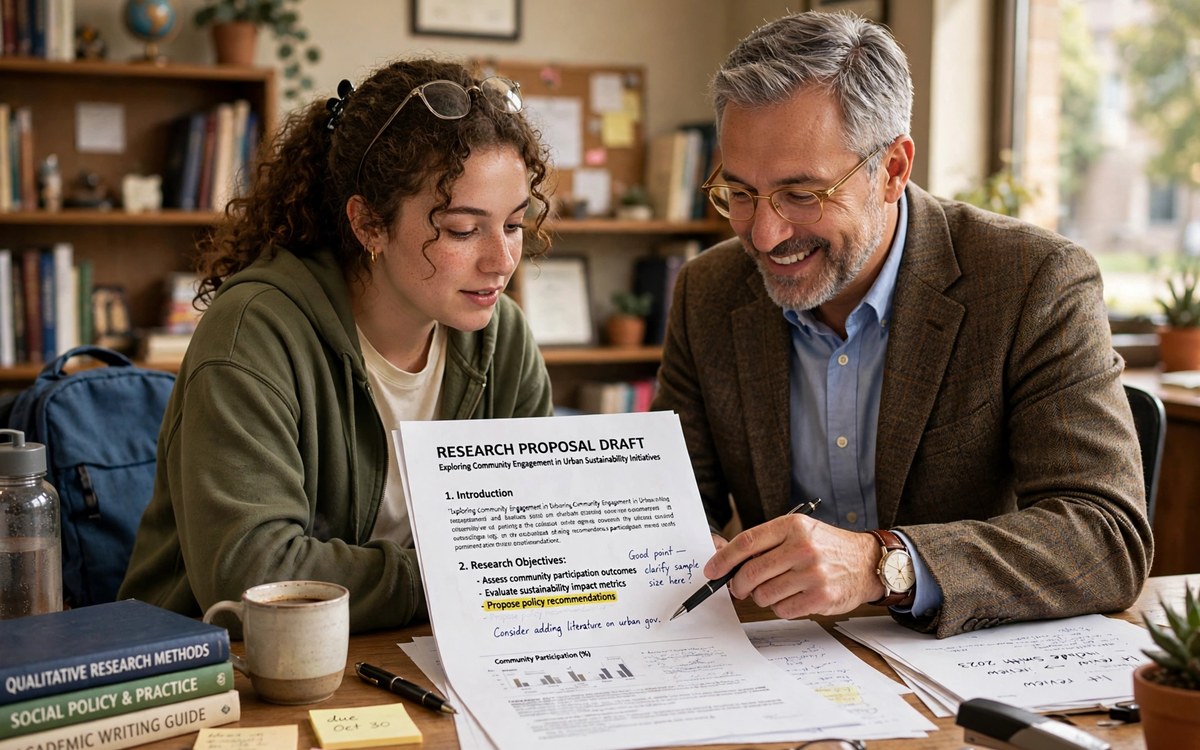
No proposal should meet its reviewer before it has met a friendly reader. Your supervisor sees the field; a friend outside your field sees whether a stranger can follow it. Give them the draft with one instruction: 'Tell me where you got lost or bored.' Those are the exact places the reviewer will stall. Revise, then read the whole thing aloud once — clumsy sentences hide in silence and reveal themselves in speech.
One honest conversation with a mentor catches more problems than a week of solitary polishing.
Why proposals get rejected
No sharp question — a topic described at length instead of a question stated plainly.
No visible gap — the literature review summarises without showing what is missing.
Vague methodology — the reviewer cannot tell what you will actually do on day one.
Unrealistic scope — a PhD-sized project proposed for a six-month dissertation.
Ignoring the guidelines — wrong length, missing sections, or a budget the call did not ask for.
Sloppy surface — typos and inconsistent citations suggest the research will be sloppy too.
Formatting and length
There is no universal page count — a dissertation proposal might be five pages, a grant application thirty. The only rule is to follow the call: its headings, its word limits, its reference style. Reviewers notice compliance because non-compliance wastes their time. When no format is given, the table above is a safe skeleton, and clarity beats length every time.
A proposal is a small document with one job: to make a busy, sceptical reader believe in your question and your ability to answer it. Start with the sharp question, show the gap, describe the method as if someone must repeat it, and let a friendly reader find the weak spots before the reviewer does. Do that, and approval stops feeling like luck.
Frequently asked questions
How long should a research proposal be?
As long as the call or your department asks for — that is the only number that matters. Dissertation proposals are often 1,500 to 3,000 words; grant proposals can run much longer. When no length is given, aim for the shortest document that still answers the reviewer's three questions: is it worth doing, can you do it, and what will it produce.
Can I change my topic after the proposal is approved?
Usually yes, within reason — proposals are plans, not contracts, and research questions often sharpen once work begins. Small refinements are normal and expected. A wholesale change of topic normally needs your supervisor's or committee's agreement, so keep them in the loop early rather than presenting a surprise.
How much literature review is enough?
Enough to prove the gap. That usually means the key studies that define the current state of knowledge on your specific question — often a dozen or two well-chosen sources rather than a hundred skimmed ones. If every citation is marching toward your gap sentence, you have enough; if you are citing to look thorough, you have too many.
What if my supervisor disagrees with my research question?
Take it seriously — they know the field's dead ends. Ask what specifically worries them: feasibility, originality, or scope. Often the question survives in a narrower version both of you can support. A supervisor who argued with your proposal is a supervisor who will defend it later.
Do I need preliminary results in my proposal?
For most student proposals, no — but a small pilot strengthens any proposal enormously. Even five trial interviews or a quick analysis of a sample dataset proves your method works and your access is real. If you have pilot data, give it a short section; reviewers read it as evidence you have already started.
The Fundora Editorial Team is a small group of educators, researchers and tech writers. We test the tools and methods we recommend, prefer free options, and update our guides when things change.
Your thesis topic will live with you for months, so choose it properly. Learn how to brainstorm widely, test ideas against interest, feasibility and contribution, and narrow a vague interest into a question you can actually finish.
Research papers are not novels. Learn the three-pass method — skim, read, interrogate — with time budgets, a comparison table and the five-question note that makes papers stick.
Set up Zotero from scratch: install the connector, save references in one click, organise collections, and generate a perfectly formatted bibliography.
15 October 2026· 7 min read
The Fundora Letter
Never miss a post
One useful guide, every Sunday — the week's best study, research and AI-tool guides, delivered quietly to your inbox. No spam, no selling your address — unsubscribe any time.
Signups are handled by Brevo, our email service — your address is stored on Brevo's servers so we can send the letter. It is never sold, and every issue has an unsubscribe link.
Fundora uses cookies to analyse traffic and improve your experience. Learn more