How to Read a Research Paper: The Three-Pass Method for Students
Research papers are not novels. Learn the three-pass method — skim, read, interrogate — with time budgets, a comparison table and the five-question note that makes papers stick.
Most students open a research paper, start at the first sentence of the introduction, and read in a straight line until they stall somewhere in the methods section — usually around page four, usually feeling lost. The problem is rarely intelligence. Papers are not written to be read in a straight line; they are written to be interrogated. Experienced researchers know this, which is why they skim first, read second, and argue third. This guide teaches that approach as a simple system: three passes, each with a different job, plus a five-question note that turns reading into something you can actually use in your own work.
Who this guide is for
This guide is for undergraduates meeting journal articles for the first time, master's students facing a literature review, and new PhD candidates who suspect everyone else reads faster than they do. (They do not. They skim better.) If you have ever downloaded twelve papers and finished none of them, this system is for you.
Why papers feel so hard to read
A research paper is compressed. Authors write for the fifty specialists worldwide who already share their vocabulary, their methods and their open questions — and you are reading over those specialists' shoulders. Every paragraph assumes three papers you have not read. That is not a flaw in you or in the paper; it is simply what the genre is.
The good news: a paper's structure is a map, and the map is always drawn the same way. The abstract is the whole journey in miniature. The introduction states the question. The methods are a recipe. The results are the evidence. The discussion is the argument about what the evidence means. Once you see the map, you no longer have to start at the entrance — you can walk straight to the room you need.
Start with a purpose, not a page
Before pass one, decide why this paper is in front of you. There are really only three purposes:
Screening — deciding whether this paper is relevant to your question at all.
Understanding — you need to be able to explain its method or findings to someone else, perhaps in a seminar or an essay.
Using — your own work will build on it, cite it, compare against it, or try to replicate it.
Your purpose decides how many passes the paper earns. Most papers deserve one pass. A few deserve two. Only the papers at the centre of your project deserve three. Reading everything at maximum depth is not diligence — it is how reading lists die.
Pass one: the five-minute skim
Pass one is a survey, not a read. Move fast, and cover exactly these five things (this is the first pass of the three-pass method described by S. Keshav of the University of Waterloo, widely taught in graduate schools):
Read the title and abstract slowly — they are the author's own summary of the question and the answer.
Read every heading and subheading, to see the shape of the argument before any of its details.
Look at every figure and table, reading only the captions. In most fields, the figures are the results.
Read the first paragraph of the introduction and the whole conclusion.
Glance through the references. Names and journals you recognise tell you whose conversation this paper joins.
Then stop, and answer three questions in plain words: What question does this paper ask? What did it find? Is it relevant to me? If you can answer all three, pass one has done its job. For a screening purpose you are finished — in five minutes instead of fifty, with a clear conscience.
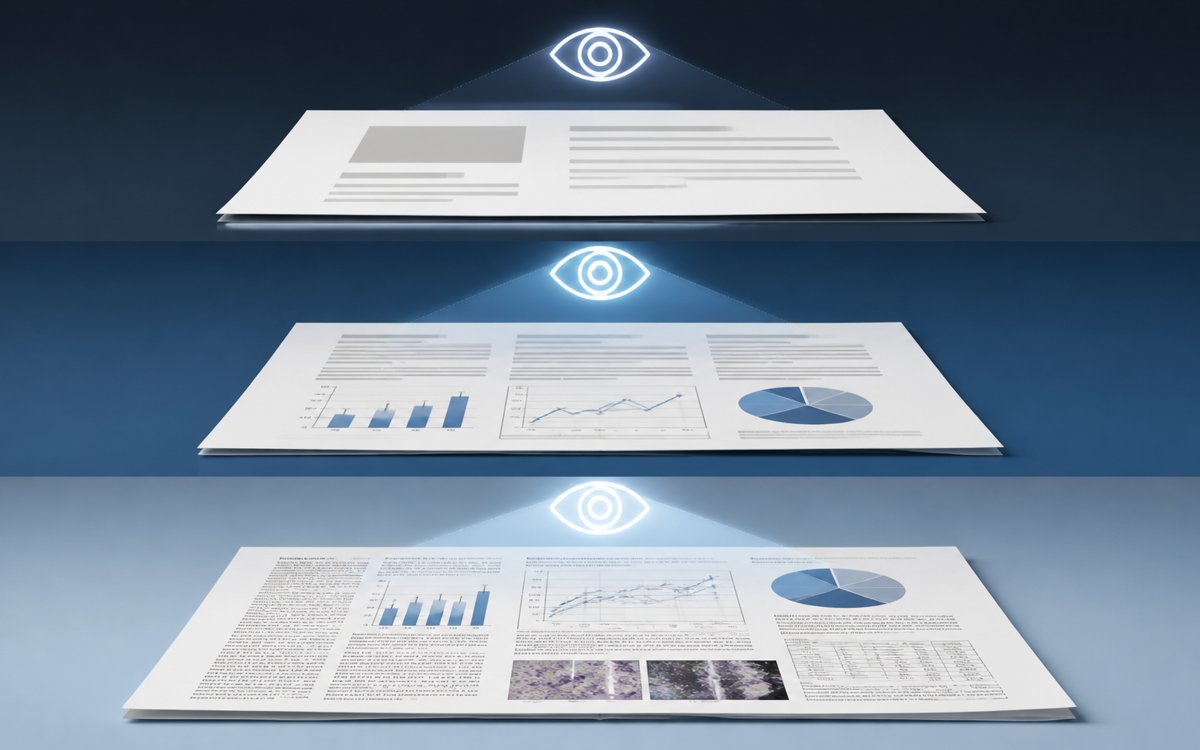
One paper, three passes — each layer adds detail only where the previous layer showed it matters.
Pass two: read for the argument
Now read the paper properly — introduction, results and discussion in full — but give yourself permission to skip dense proofs, derivations and technical detail on this pass. You are following the argument: what is claimed, and what evidence is offered for it? Follow the order of the figures; in a well-built paper, the figures tell the story and the text annotates them.
Read with a pen. At the end of each section, write a one-line summary in the margin in your own words. Mark every place you get lost or disagree — do not resolve these on the spot, just flag them. Those flags are the raw material of pass three, of seminar discussions, and of your own research questions. Expect 30 to 60 minutes for this pass on a typical paper.
Pass three: interrogate the paper
Pass three is reserved for the handful of papers your own work stands on. Here you try to mentally recreate the study — and to break it. Work through these questions in writing:
What exactly is the claim, stated in one sentence?
What evidence is offered — and does it support the claim, or only a smaller one?
What assumptions does the method quietly depend on?
Did the authors test the obvious alternative explanation?
What limitations do the authors admit — and are there ones they do not?
If I repeated this study, where would it most likely break?
You will not always have answers. The questions are the point: they convert a paper from something you have read into something you can defend, criticise, or build on — which is what your examiners, reviewers and future self actually need.
Pass
Time
Your job
What to skip
1 — Skim
5 minutes
Decide whether the paper matters to you
Body text beyond headings, intro and conclusion
2 — Read
30–60 minutes
Follow the argument and the evidence
Dense proofs and maths — revisit only if needed
3 — Interrogate
1–3 hours
Stress-test claims, assumptions and limits
Nothing — but reserve it for core papers only
Most papers in your library should get pass 1 only. Pass 3 is for the handful your own work stands on.
The five-question note
However many passes a paper gets, finish with the same ten-minute note. Five questions, answered in your own words, in a notebook, a paper log spreadsheet, or your reference manager:
What question does this paper answer?
What did it find, in one or two sentences?
How do I know — what method or evidence carries the claim?
What are its limits?
How does it connect to my project — cite it, build on it, argue against it, or ignore it?
This note is the real product of reading. Six months later, when you are writing the literature review, the note is what you will actually use — not the highlighted PDF you no longer remember opening.
Handy tip
Read with a pencil, not a highlighter. Highlighting feels productive and mostly is not; a five-word margin note ("weak control group") is worth a page of yellow.
Your notes are the real product of reading. The five questions take ten minutes and save hours later.
Pro tips from people who read papers for a living
Read the conclusion before the methods. Knowing where the author lands makes the middle sections legible.
From any core paper, follow one reference backwards and one citation forwards. That pair teaches you the field's family tree faster than random searching.
Keep a 'confused list'. Terms and ideas that recur across three papers are the ones worth an hour of proper study.
Stop at your planned pass. Time already spent is not a reason to give a weak paper a third pass.
Troubleshooting: when a paper still won't yield
The vocabulary defeats you. Read a review paper or a textbook chapter on the topic first. Research papers assume the review you skipped; one good review unlocks a shelf of papers.
The maths defeats you. On pass two, read the sentences around the equations — authors almost always state their conclusions in words. Return to the maths on pass three only if your own work depends on it.
Every paper seems equally important. That is a purpose problem, not a reading problem. Write your research question in one sentence, keep it above your desk, and screen against it without mercy.
You forget everything within a week. Normal — memory needs retrieval, not exposure. The five-question note, plus a fifteen-minute weekly skim of your paper log, fixes most of it.
Reading papers is a skill with a technique, not a talent other people were issued at birth. Start with your next paper: five minutes, three questions, one honest note. The pile shrinks — and what remains actually serves your work.
Frequently asked questions
How long should it take to read one research paper?
It depends on the pass. About five minutes for a skim that decides relevance, 30–60 minutes to follow the argument properly, and one to three hours to interrogate a core paper. If every paper takes you two hours, you are giving pass-three effort to pass-one papers.
Should I read the abstract first or last?
First, while you are learning. The abstract is the author's own map of the paper — question, method, headline result. Some experienced researchers read it last so they can form an independent view of the evidence, but for students the map is worth more than the purity.
What if I don't understand the statistics or maths?
Skip it on pass two and mark the spot. Read the sentences around the equations, where authors state their conclusions in words. Go back and learn the technique only if the paper's main claim stands on it — or if the same method keeps appearing across your field.
How many papers should I read each week?
Fewer than you think, with notes. Three papers read with the five-question note will serve an essay or a thesis chapter better than twenty skimmed and forgotten. During a literature review's screening phase the balance flips: many pass-one skims, few deep reads.
The Fundora Editorial Team is a small group of educators, researchers and tech writers. We test the tools and methods we recommend, prefer free options, and update our guides when things change.
Your thesis topic will live with you for months, so choose it properly. Learn how to brainstorm widely, test ideas against interest, feasibility and contribution, and narrow a vague interest into a question you can actually finish.
A research proposal is a promise and a plan. Learn the sections reviewers expect, how to frame a sharp question, write a methodology that survives scrutiny, and the feedback loop that turns a draft into an approval.
Set up Zotero from scratch: install the connector, save references in one click, organise collections, and generate a perfectly formatted bibliography.
15 October 2026· 7 min read
The Fundora Letter
Never miss a post
One useful guide, every Sunday — the week's best study, research and AI-tool guides, delivered quietly to your inbox. No spam, no selling your address — unsubscribe any time.
Signups are handled by Brevo, our email service — your address is stored on Brevo's servers so we can send the letter. It is never sold, and every issue has an unsubscribe link.
Fundora uses cookies to analyse traffic and improve your experience. Learn more