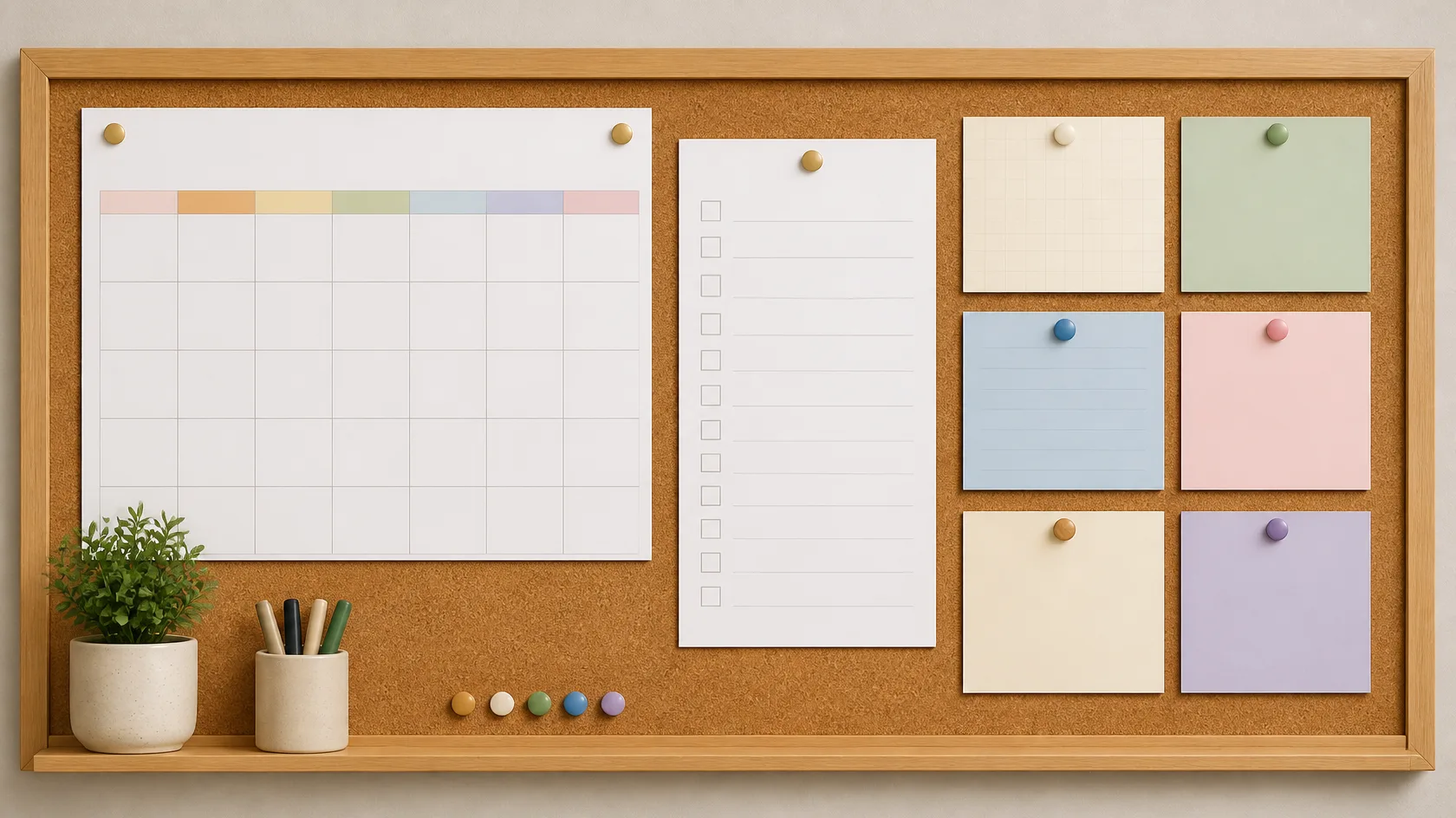
Time Blocking for Students: Plan a Week That Survives Real Life
To-do lists tell you what to do, not when to do it. Learn how to block your week into realistic chunks for classes, study, rest and life, with buffers that keep one bad day from wrecking the whole plan.
Here is a familiar student Sunday night. You write a long to-do list, you feel briefly organised, and then Monday happens. A lecture runs over, a friend needs help, you fall into a two hour scrolling hole, and by Wednesday the list is a guilt document you avoid looking at. The problem is not laziness. A to-do list tells you what needs doing, but it never tells you when you will actually do it. Time blocking fixes that one gap. You give each task a home in your week, a start time and an end time, and then you just follow the plan instead of re-deciding everything fifty times a day.
Who this guide is for
This guide is for any student whose week feels like it happens to them: undergraduates juggling classes and part time work, masters students writing alongside taught modules, and anyone who has ever said 'I will study this weekend' and then watched the weekend evaporate. You do not need a fancy app or a perfect routine. You need a paper planner or a calendar app, about half an hour on Sunday, and a willingness to plan a week you can actually live with.
What time blocking actually is
Time blocking is simple, which is why it works. Instead of keeping a list of tasks floating in the air, you assign each task to a specific block of time. 'Write essay outline' becomes 'Tuesday, 10:00 to 11:30, library, essay outline'. That is the whole idea. The block is an appointment with yourself, and you treat it roughly the way you treat a class: you show up, you do the thing, and when the block ends, you stop, even if the work is not finished. Stopping on time is part of the system, not a failure of it. It is what keeps one task from eating your entire day.
It helps to be clear about what time blocking is not. It is not a minute by minute schedule for your whole life, and it is not a test of willpower. A plan that leaves no room for meals, rest, friends or surprises is not a good plan. It is a fantasy that will collapse by Tuesday lunch. Good time blocking plans the important stuff first, then protects the rest of your life around it, not the other way round.
A block has one job. 'Study' is too vague. 'Revise biology chapter 4 and make flashcards' is a block.
A block has a start and an end. Open ended study sessions drift. A 90 minute block with a clear finish keeps you honest.
A block lives in your calendar, not just in your head. If it is not written down somewhere you will actually look, it does not exist.
Your week needs empty blocks too. Unplanned time is not wasted time. It is the shock absorber that keeps the plan alive.
Start with your fixed blocks
Never start a weekly plan with a blank page. Start with the things that are already decided for you. Your classes, your shifts, your society meetings, your regular commitments: these are the fixed blocks, and everything else has to fit around them. Write them in first, in one colour or with one label, before you plan anything else. Most students are surprised by how much of the week is already spoken for, and that surprise is useful information. It stops you from planning ten hours of study into a day that only has three free hours in it.
Fill in every fixed commitment for the week: lectures, seminars, labs, work shifts and regular appointments.
Add the non-negotiables: sleep, meals and travel time. Be honest about these. A plan that assumes you will sleep five hours a night is not ambitious, it is broken.
Look at what is left. Those gaps are your real study time, and they are almost always smaller than you imagined. That is fine. Planning around reality beats planning around hope.
Now, and only now, place your study blocks into the gaps, starting with the task that is due soonest or that worries you most.
Block type
What goes in it
A realistic size
Deep study
One assignment, one chapter, one problem set
60 to 90 minutes
Light study
Flashcards, reading, organising notes
30 to 45 minutes
Admin
Emails, forms, printing, planning
30 minutes, once a day at most
Buffer
Overflow, errands, or nothing at all
30 to 60 minutes a day
Rest
Meals, walks, friends, proper downtime
Protected, never the leftover
If every block is 'deep study', the plan will not survive first contact with a real day. Mix the block types the way a real week mixes them.
Colour helps, but the colours are not the point. One block, one job, one start and end time: that is the whole method.
Build your first week in about thirty minutes
Set a timer, sit down on Sunday, and work through this in order. The first time takes a little longer. By week three you will do it in fifteen minutes while drinking your coffee, because most of your fixed blocks barely change from week to week.
Copy last week's fixed blocks into this week, then add anything new: deadlines, exams, one-off appointments.
Pick your three most important study tasks for the week. Not ten. Three. These get the best blocks, the times when you focus most easily.
Place those three tasks first, in specific blocks, with a clear finish line for each one. 'Draft introduction' beats 'work on essay'.
Add smaller tasks around them: readings, flashcards, revision. Keep each block to one job.
Add one buffer block per day, ideally in the afternoon, when things tend to slip. Label it 'catch up' so you can see it is there on purpose.
Block your rest too. A walk with a friend, a proper lunch, an evening off: if it is not in the plan, study will quietly eat it.
Look at the whole week once, honestly. If it looks exhausting, it is. Remove something now, while it is cheap to remove, rather than failing at it on Thursday.
The part everyone skips: buffers and white space
Here is the secret of plans that actually survive: they are deliberately unfinished. A week with no empty space has no way to absorb a late bus, a long lecture, a headache or a friend in crisis. One delay knocks everything sideways, and then the whole plan feels ruined, so you abandon it. A buffer block changes that completely. When something overruns, it eats the buffer, not your evening, and the rest of the week stays standing. Think of buffers as the pavements on a road. Nobody plans a journey that uses every inch of tarmac. Your week needs the same margin.
Handy tip
The two hour rule: never plan more than two hours of deep study in a row without a real break. Your brain is not a machine, and the third hour of a marathon session usually produces less than the first twenty minutes of a fresh one.
When the week falls apart, and it will
Let us be honest: some week, soon, your plan will fall apart. A deadline will move, you will get ill, or life will simply get in the way. This is not the plan failing. This is the plan doing its real job, which is to make recovery easy. When a block is missed, do not try to cram it into the same day on top of everything else. That is how one missed block becomes three missed blocks and a miserable evening.
Move it, do not delete it. A missed study block goes into your next buffer block or into tomorrow's free gap, not into the bin.
Shrink it before you skip it. A 90 minute block you cannot face can become a 25 minute version. Twenty five honest minutes beat zero guilty minutes.
Do a ten minute reset each evening. Look at tomorrow, move one or two blocks if you must, and then stop fiddling. Five minutes of replanning beats an hour of worrying.
Protect the next morning. One bad day is an incident. Two bad days in a row usually start with a ruined night's sleep, so guard your bedtime block like a class.
Moving a block is not failing the plan. It is the plan working: the week bends so it does not break.
Paper planner or calendar app
Both work, and the honest answer is that the best tool is the one you will actually open. Paper planners are satisfying to fill in, they keep your plan visible on your desk, and they do not buzz at you. Calendar apps send reminders, let you drag blocks around in seconds, and live on the phone you already carry. Many students use both: a paper planner for the weekly overview on Sunday, and a phone calendar for reminders during the week. Try one for two full weeks before deciding it does not work. A tool judged after one messy day has not really been tried.
Whatever you choose, keep one rule: one plan, one place. A paper planner plus a calendar app plus a notes app plus sticky notes on your laptop is not a system. It is four half systems arguing with each other. Pick your home for the plan, and let everything else point to it.
A realistic sample week
Imagine a student with classes on weekday mornings, a part time shift on Saturday, and an essay due in two weeks. Their week might look like this: Monday to Friday mornings are fixed blocks for classes. Three afternoons hold 90 minute deep study blocks, each with one job, like drafting one essay section or finishing one problem set. Two shorter blocks hold flashcards and reading. Every day has a buffer block in the late afternoon. Evenings are mostly free, with one evening set aside for a society meeting and one kept completely clear. Saturday morning is the shift, Saturday afternoon is rest, and Sunday holds a 30 minute planning session plus one light study block. Nothing heroic. Nothing that requires superhuman discipline. Just a week where the important work has a home, and the rest of life has a home too.
Troubleshooting: when time blocking feels wrong
You keep ignoring the plan. The plan is probably too strict, not you too weak. Cut the number of blocks, shorten them, and add more buffer. A plan you follow at 70 percent beats a perfect plan you abandon by Tuesday.
You plan, but the work still does not get done. Check whether your blocks have one clear job. 'Study chemistry' is a wish, not a block. 'Do ten practice problems from chapter 6' is a block, and you will know when it is finished.
You feel guilty during rest blocks. That guilt is the old to-do list talking. Rest is in the plan on purpose. A rested student on Monday morning outperforms an exhausted student who 'studied' all weekend. Protect rest the way you protect a deadline.
Your week is genuinely full. If classes, work and commuting leave almost no gaps, the answer is not a cleverer plan. It is fewer commitments, or smaller study blocks, or asking for help. Talk to a tutor or an advisor early. A timetable problem solved in week three is a small conversation. The same problem in week ten is a crisis.
Time blocking will not make you a different person, and it will not give you more hours than anyone else has. What it does is smaller and more useful: it stops you spending your limited hours re-deciding, feeling guilty and starting late. Plan the week on Sunday, give each task a home, leave room for real life, and when the plan bends, bend it back gently instead of throwing it away. That is the whole skill, and it gets easier every week you practise it.
Frequently asked questions
How is time blocking different from a to-do list?
A to-do list says what needs doing. Time blocking also says when you will do it, for how long, and what counts as finished. That one change removes most of the daily decision making that eats student time. You still keep a list of tasks, but the list feeds the calendar instead of floating on its own.
How much of my day should I time block?
Block your fixed commitments and your important study tasks, and leave the rest open. Most students do well blocking roughly half to two thirds of their waking hours, with buffers and free time inside that. Blocking every minute leaves no room for life, and a plan with no room for life is a plan you will abandon.
What if I never stick to the times I set?
First, make the plan easier, not stricter: fewer blocks, shorter blocks, more buffer. Second, check that each block has one specific job, because vague blocks are easy to avoid. Third, try planning the night before instead of a week ahead, until the habit feels natural. Sticking to a plan is a skill that improves with practice, not a character trait you either have or lack.
Does time blocking work for irregular weeks?
Yes, and irregular weeks are where it helps most. You cannot copy last week's plan, so you spend the same 30 minutes on Sunday building a fresh one around this week's actual commitments. The method stays the same: fixed blocks first, three most important tasks next, buffers every day. The plan changes, the habit does not.
Should I use an app or a paper planner?
Use whichever one you will open every day. Apps give reminders and easy dragging. Paper gives a visible weekly overview and fewer distractions. Many students combine them: paper for the Sunday planning session, phone calendar for reminders. The tool matters far less than the habit of planning once a week and checking the plan each morning.
The Fundora Editorial Team is a small group of educators, researchers and tech writers. We test the tools and methods we recommend, prefer free options, and update our guides when things change.
Anki turns revision into a daily habit that actually sticks. Learn how spaced repetition works, how to write cards that teach rather than test your patience, and the simple routine that keeps reviews under twenty minutes a day.
Design a simple Notion dashboard for assignments, deadlines, notes and revision — using only the free plan, with a page structure you can copy in an hour.
25 September 2026· 6 min read
The Fundora Letter
Never miss a post
One useful guide, every Sunday — the week's best study, research and AI-tool guides, delivered quietly to your inbox. No spam, no selling your address — unsubscribe any time.
Signups are handled by Brevo, our email service — your address is stored on Brevo's servers so we can send the letter. It is never sold, and every issue has an unsubscribe link.
Fundora uses cookies to analyse traffic and improve your experience. Learn more