Design a Deep-Focus Study Environment: Light, Sound, Phone and Rituals
Your surroundings quietly decide how well you concentrate. A practical guide to setting up a study space — and a start-of-session ritual — that makes focus the default.
Willpower is a terrible study strategy because it runs out. Environment design is a better one: arrange your space so that the focused choice is the easy choice, and concentration stops depending on mood. Four levers matter most — light, sound, your phone, and a starting ritual.
Who this guide is for
This guide is for students whose study sessions dissolve — twenty minutes of setup, a phone checked 'just once', and suddenly the afternoon is gone. It treats focus as a design problem rather than a character trait. You will change physical things — light, sound, the phone's location, and the first two minutes of a session — because physical changes hold on the days motivation does not.
Light: bright, front-facing, boring
Daylight is best; sit facing or beside a window rather than with it behind your screen. In the evening, a bright desk lamp that lights the page and keyboard — not the room in general — keeps your brain in 'daytime work' mode. Dim, warm, cosy lighting is lovely for reading novels and quietly disastrous for problem sets.
A word on brightness and eyes while we are on light: your screen should roughly match the brightness of the room around it. A glowing screen in a dark room forces your eyes to work at two light levels at once and tires them faster; a desk lamp that lights the whole desk area, not just a pool on the page, keeps everything in one comfortable range. If evening study regularly ends with a headache, this mismatch — not the studying — is the first suspect.
Sound: consistent beats silent
Total silence makes every small noise an event. A consistent sound floor — a fan, quiet instrumental music, or low café ambience — masks interruptions. Lyrics compete with reading and writing for the same language machinery, so keep words out of your study audio. Whatever you choose, use the same sound only for studying; it becomes a context cue.
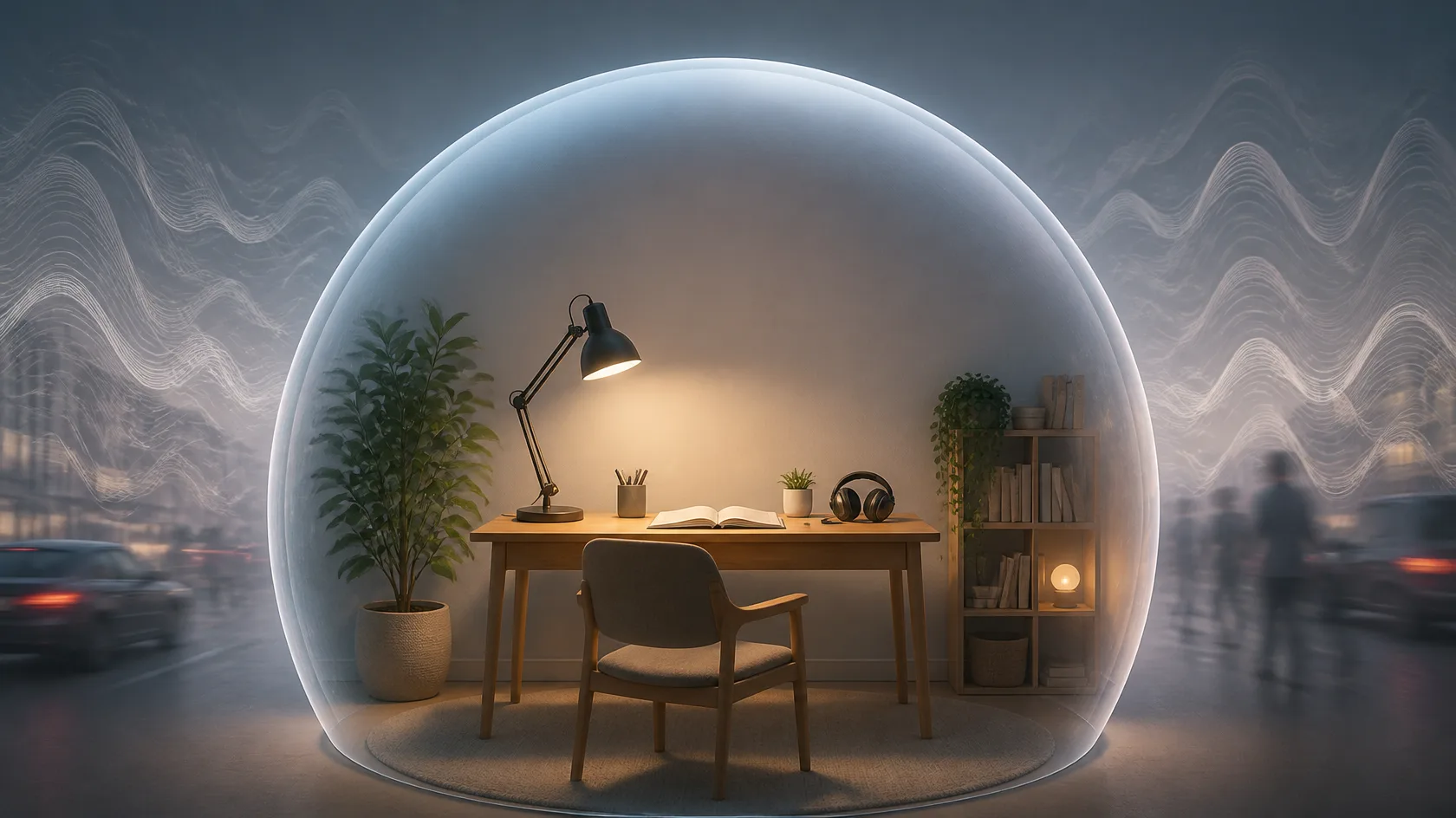
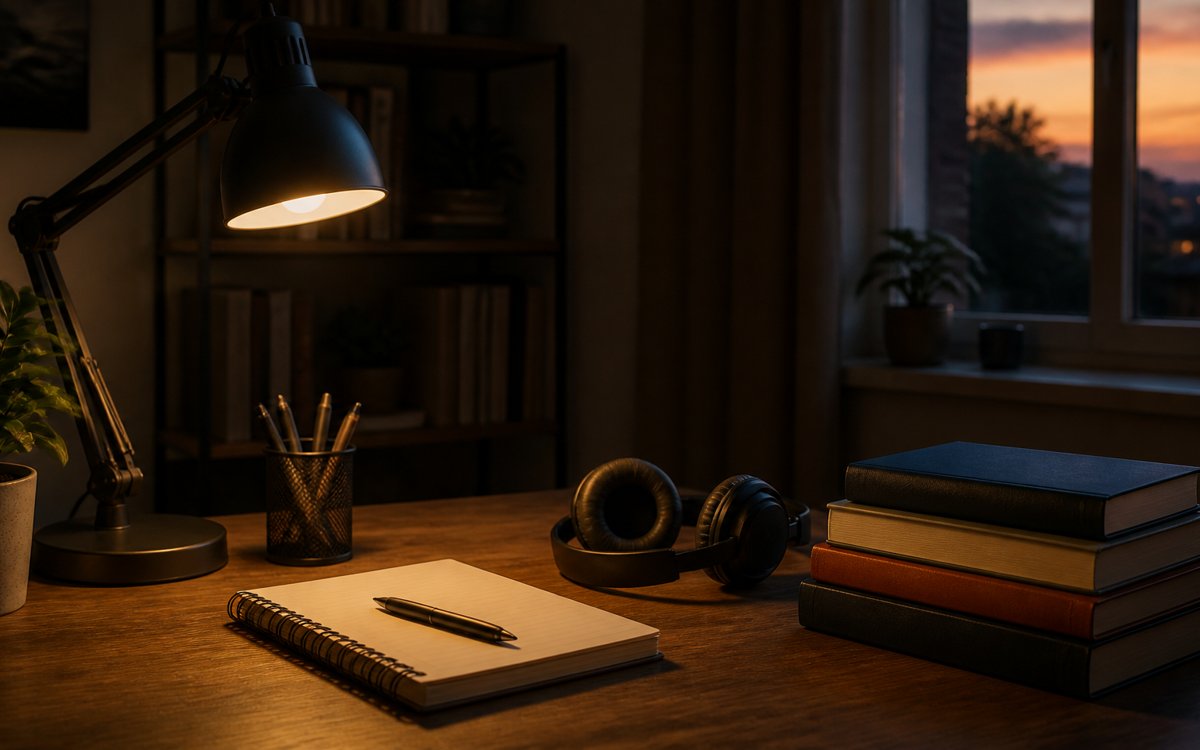
Light, sound and a clear desk: the environment does half the focusing for you.
The phone: out of the room, not face-down
Research on attention keeps reaching the same awkward conclusion: a visible phone taxes concentration even when it is off, and 'face-down on the desk' is barely better. Put it in another room, or in a drawer with a timer lock if another room is impossible. Tell the two or three people who might genuinely need you which times you check messages — then checking becomes a scheduled event, not a reflex.
Handy tip
If another room is not possible, the 'phone hotel' works: phone in a closed box or bag, on a shelf behind you, for the length of one study block. Friction, not willpower.
A focus-friendly desk checklist
One task's materials only — everything else in a drawer or on the floor behind you.
Water within reach, so 'getting a drink' never becomes a kitchen tour.
Timer visible, phone invisible (another room, or boxed behind you).
Study sound ready to start with one tap — the same sound as always.
A notepad for intruding thoughts and to-dos; capture them, do not chase them.
Chair and screen at a height you can hold for an hour — discomfort is a distraction with a slow fuse.
Print it, tape it to the wall, and run it top to bottom for a week. Checklists are how pilots and surgeons remove willpower from jobs that matter; a study session is smaller, but the principle is identical.
A focus bubble is built from small decisions made before the session starts.
A two-minute starting ritual
Clear the desk to only the current task's materials.
Write the session's single goal on a sticky note and place it in view.
Start your study sound and your timer.
Open the document or book before sitting fully down — begin in motion.
Rituals sound superstitious until you notice what they replace: the ten-minute drift of 'settling in' that eats the start of every session. A fixed sequence tells your brain the session has begun, and the beginning is where most focus battles are won.
When you cannot control the space
Shared flats and busy libraries are real. The levers still apply in portable form: a bright clip-on lamp, noise-isolating earphones with your study sound, the phone in your bag, and the same sticky-note ritual. Environment is a practice, not a postcode.
Pro tips that compound
Keep the same place and approximate time for studying. Context cues work like compound interest: each session in the same setup makes starting the next one cheaper.
Borrow a person: 'body doubling' — studying alongside someone else who is also working, in person or on a quiet video call — is a well-known focus aid, especially for tasks you have been avoiding. The other person does not help; their presence is the help.
End each session by leaving the next one set up: book open at the right page, goal note written. Tomorrow's start is decided by today's last two minutes.
Be boring about caffeine: a consistent, modest amount early in your study day. Using it as an emergency lever most afternoons degrades the evening and the sleep that consolidation depends on.
Troubleshooting: when the environment fights back
Noisy housemates and thin walls. You cannot redesign people, so negotiate the one hour that matters ('exam hour' with a door sign works better than all-day pleas), and move your hardest block to the library or an early hour when the flat is quiet. Noise-isolating earphones plus your study sound cover the rest.
The post-lunch collapse. Schedule against biology, not against the clock: put mechanical tasks (flashcards, formatting, organising) in the slump, and take a ten-minute walk in daylight before the session — light and movement beat a third coffee for afternoon alertness.
The ritual became the procrastination. If 'setting up' regularly takes fifteen minutes, your ritual has been colonised. Shrink it back to the two-minute, four-step version in this guide and time it once. Setup that cannot expand cannot eat the session.
You genuinely need the phone nearby (family, work, two-factor codes). Reduce it rather than banishing it: notifications off except calls from starred contacts, the phone face-down inside a bag across the room. You will still hear the emergency; you will not see the feed.
Change one lever this week — most students should start with the phone — and notice how much less effort the same work takes.
Frequently asked questions
Is music or silence better for studying?
It depends on the task. For reading and writing — anything language-heavy — lyrics compete directly with the words on the page, so instrumental sound or silence wins. For mechanical tasks (problem drills, drawing, data entry), familiar music often helps people persist. Whatever you choose, consistency turns it into a focus cue.
How long before a study setup starts feeling automatic?
Most students notice the shift within two to three weeks of near-daily use: starting gets easier before it gets effortless. The cue effect builds with repetitions, so five short sessions in the same setup beat one heroic weekend.
Do focus apps and website blockers actually help?
They help with one lever — the phone and the browser — by adding friction at the moment of temptation. They cannot fix light, sound or an undefined task. Use them as the lock on a door your environment has already closed, not as the door itself.
What is the single cheapest upgrade I can make?
A decent desk lamp, for most people. It fixes the evening light mismatch, defines the study zone visually, and costs less than a textbook. Second place: a cheap kitchen timer, which frees your phone to live in another room.
Should I study in bed to be comfortable?
Better not, as a habit. Beds are your brain's strongest sleep cue; working there blurs both directions — study feels drowsy and sleep gets worse. If the bed is genuinely your only space, sit up on top of the covers with your lamp and ritual, and keep lying down strictly for sleeping.
The Fundora Editorial Team is a small group of educators, researchers and tech writers. We test the tools and methods we recommend, prefer free options, and update our guides when things change.
To-do lists tell you what to do, not when to do it. Learn how to block your week into realistic chunks for classes, study, rest and life, with buffers that keep one bad day from wrecking the whole plan.
Anki turns revision into a daily habit that actually sticks. Learn how spaced repetition works, how to write cards that teach rather than test your patience, and the simple routine that keeps reviews under twenty minutes a day.
How the Pomodoro Technique works, how to adapt the classic 25-minute cycle to deep study, and the common mistakes that make people quit in week one.
12 October 2026· 6 min read
The Fundora Letter
Never miss a post
One useful guide, every Sunday — the week's best study, research and AI-tool guides, delivered quietly to your inbox. No spam, no selling your address — unsubscribe any time.
Signups are handled by Brevo, our email service — your address is stored on Brevo's servers so we can send the letter. It is never sold, and every issue has an unsubscribe link.
Fundora uses cookies to analyse traffic and improve your experience. Learn more